August 26, 2026
How to Talk to Your Child About Grief Without Saying the Wrong Thing
You do not need the perfect words to help a grieving child. That is one of the first myths worth setting down. Many parents and educators worry that one awkward sentence, one…

You do not need the perfect words to help a grieving child.
That is one of the first myths worth setting down. Many parents and educators worry that one awkward sentence, one mistimed explanation, or one visible tear will somehow make a child’s grief worse. But children do not need a flawless guide. They need a steady companion: someone willing to stay close when the feelings become sharp, confusing, or quiet.
Grief is not a single conversation. It is a season, then another season, then a sudden ache on an ordinary Tuesday because a song, smell, birthday, or empty chair brings everything back. Your child may cry intensely one moment and ask for a snack the next. They may seem cheerful at school, then become clingy at bedtime. This does not mean they are pretending or “over it.” Children often move in and out of grief in small waves, however.
Your presence matters more than performance. You can listen, tell the truth, offer comfort, and return to the conversation again and again.
Begin with clear, gentle truth
When you are talking about death, use simple and direct language. Say “died” rather than “went to sleep,” “went away,” or “we lost them.”
Euphemisms may sound softer to an adult, but they can be frightening or confusing to a child. A young child might begin to fear going to sleep, worry that someone who leaves will never return, or wonder why the person cannot simply be found.
You might say:
“I have something very sad to tell you. Grandpa died. His body stopped working, and he will not come back. We will miss him very much, and I am here with you.”
You do not have to explain everything at once. Offer a few clear sentences, then pause. Let your child’s questions guide the next part.
If you do not know the answer, you can say:
“That is an important question. I don’t know the answer, but we can think about it together.”
Honesty builds safety, even when the truth is painful. You can make the language age-appropriate without making it vague.

Listen for the feeling beneath the question
Children may ask, “When is Grandma coming home?” several times, even after you have explained that she died. This repetition is not defiance. It may be the mind slowly absorbing a reality that feels too large to hold all at once.
Answer patiently, even when your own heart is tired.
“Grandma died, so she isn’t coming home. I know that is hard to understand. You can ask me again whenever you need to.”
Sometimes the loud emotion is obvious: sobbing, anger, shouting, or a frantic refusal to let you leave the room. Other times grief is quieter. It may look like stomachaches, daydreaming, irritability, trouble concentrating, sudden baby talk, or an unusual need to control small things.
You do not have to force a child to name the feeling. Instead, offer gentle observations:
- “You have been very quiet today.”
- “Bedtime feels harder since Aunt Maya died.”
- “You seem worried about me leaving.”
- “I wonder if you are missing him, even though you are also having fun.”
Then wait.
The silence may feel uncomfortable, but it gives your child room to discover what is happening inside. Listening is not doing nothing. It is making space.
Reassure your child about safety: and blame
After a death, children often worry that someone else will die soon. They may become anxious when a parent drives to work, develops a headache, or leaves the room. Some children also believe their thoughts, words, or behavior caused the death.
This is especially common in younger children, who may use “magical thinking” to make sense of events they cannot control.
Say the reassurance plainly:
“Nothing you said, did, or thought caused this to happen.”
You can also explain what will remain steady:
“You will still go to school. I will pick you up today. We will have dinner together, and you will sleep in your own bed.”
Avoid promises you cannot guarantee, such as “No one else will ever die” or “Nothing bad will happen again.” Instead, focus on the care available now:
“I am healthy, and I expect to be with you for a very long time. If you feel scared, you can always tell me. There will be grownups here to help care for you.”
Predictability can be a quiet form of comfort. Familiar meals, bedtime routines, school rituals, and regular check-ins help a child’s nervous system find its footing while the rest of life feels unsteady.
Let every feeling belong
There is no single correct way for a child to grieve.
Your child may feel sad, angry, frightened, guilty, numb, relieved, confused, or even excited about an upcoming birthday. They may miss the person and feel frustrated with them. They may laugh at a memory and then suddenly cry. These contradictions can exist together.
Try not to instruct your child to “be strong,” “cheer up,” or “stop crying.” Even loving phrases such as “At least they are no longer in pain” can unintentionally hurry a child away from their own experience.
You might say:
“You can feel sad and still play.”
“You can miss her and be angry that she died.”
“Some people cry when they grieve, and some people do not. There is no one right way.”
Your own tears do not have to be hidden. You can model healthy honesty without asking your child to take care of you:
“I’m crying because I miss him. I’m going to take a few slow breaths and ask Grandma to sit with me. You do not need to make me feel better.”
That distinction matters. Your child can see that grief is real without believing they must carry yours.
Use stories to open the door
Some children talk more easily when they are looking at pictures, building with blocks, drawing, or listening to a story. A book creates a little distance from the immediate pain. Your child can notice what a character feels before they are ready to speak about themselves.
Books for kids about grief can be especially helpful when they use clear language, warm illustrations, and room for different emotional responses. They do not replace conversation, but they can begin one.
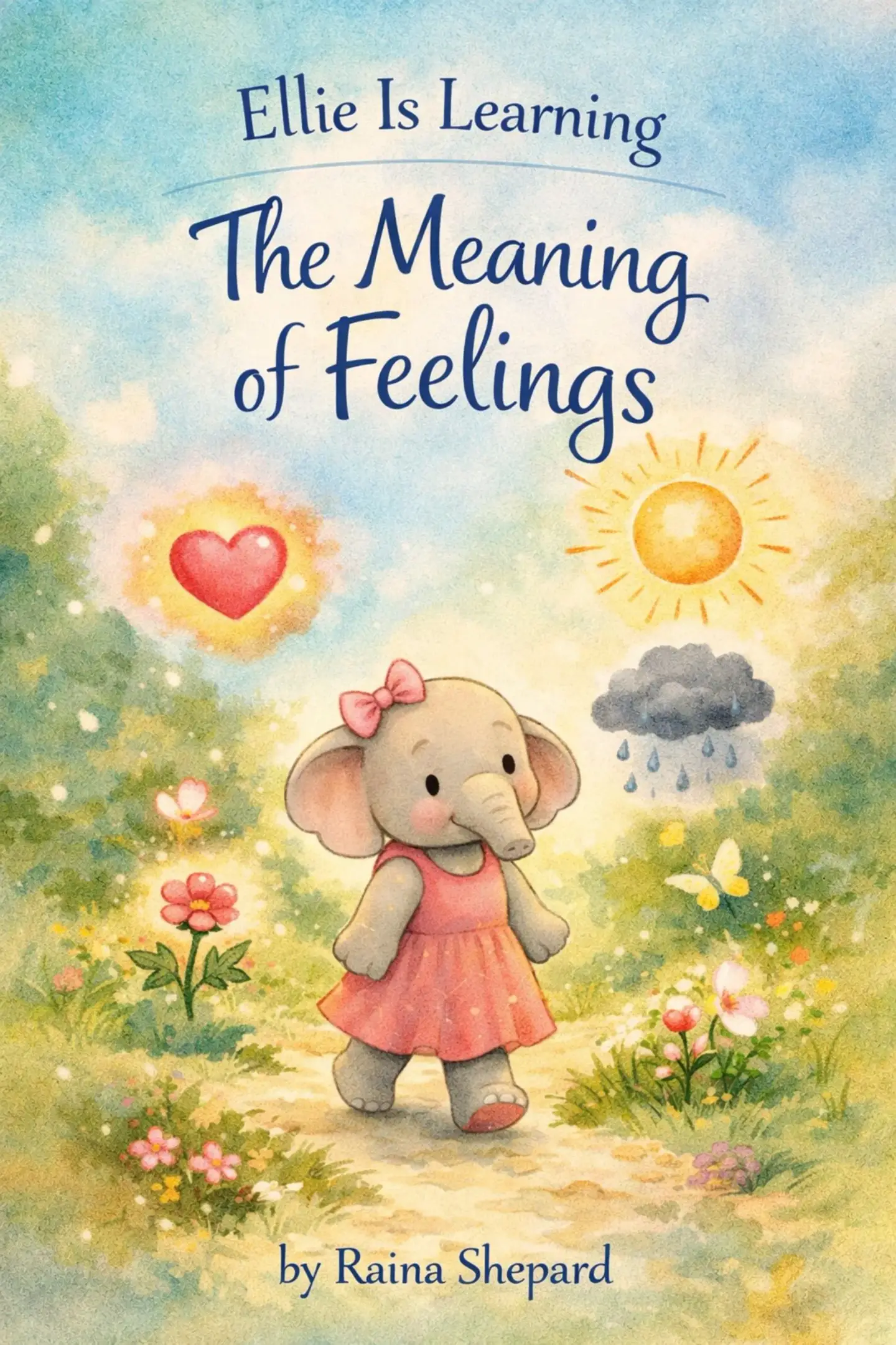
Raina Shepard’s Ellie Learns About Grief is part of the Ellie the Elephant series, which offers children gentle language for feelings such as grief, fear, courage, and belonging. You might read a few pages and ask:
- “What do you think Ellie is feeling?”
- “Have you ever felt something like that?”
- “What helped her feel less alone?”
- “Would you like to talk, draw, or just sit together?”
The goal is not to turn storytime into a lesson or quiz. Let the story breathe. Your child may answer directly, change the subject, or ask for the book again tomorrow. All three responses can be meaningful.
For children who respond to imagination and wonder, the Fairy Glitterwhisp series can offer another gentle pathway into emotional growth. Its magical world of friendship, empathy, and belonging gives children room to explore difficult feelings through symbolic stories, glowing landscapes, and caring characters.
A story does not need to mention death directly to help a child practice naming emotions, asking for support, and believing that tenderness can exist alongside pain.
Create small ways to remember
Grief needs somewhere to go. For a child, that place might be a memory box, a drawing, a garden, a letter, a favorite recipe, or a bedtime story about the person who died.
Ask permission rather than assuming:
“Would you like to look at some pictures?”
“Would you like to make a memory box, or would you rather do something else today?”
Some children want to attend a funeral or memorial service; others do not. If they attend, explain what they may see and hear, including that people may cry, laugh, pray, hug, or sit quietly. Give them choices and identify a trusted adult who can step outside with them.
Remembering should not become another obligation. A child may want to talk one day and avoid the subject the next. Follow their pace.
For educators: offer steadiness without pressure
A grieving student may need support without wanting public attention. If possible, speak privately:
“I heard that your grandfather died. I’m very sorry. You do not have to talk about it right now, but I’m here if you need a break or want to ask for help.”
Keep classroom routines familiar, while allowing flexibility with concentration, homework, participation, and transitions. A quiet corner, a movement break, extra time, or a trusted check-in can help.
Watch for the subtle signs: unfinished work, conflict with classmates, fatigue, withdrawal, sudden silliness, or difficulty separating at the end of the day. Communicate with caregivers respectfully and avoid making assumptions about what grief should look like.
A child does not need to be treated as fragile. They need to be treated as human.
Know when extra support may help
There is no exact timetable for grief. Still, reach out to a pediatrician, school counselor, or qualified child therapist if your child experiences persistent difficulty sleeping, eating, attending school, managing daily care, or connecting with others.
Seek immediate help if your child talks about wanting to die, harming themselves, or joining the person who died. In the United States, you can call or text 988 for the Suicide & Crisis Lifeline. If there is immediate danger, contact emergency services.
Asking for help is not a sign that you have failed. It is one way of surrounding your child with more care.
You may say the wrong thing sometimes. Most parents and educators do. What matters is that you return, repair, and remain available:
“I said you needed to be strong. I’m sorry. You do not have to hide your feelings from me.”
Grief cannot be fixed with the perfect sentence. However, it can become less lonely when a child is met with truth, patience, stories, and steady love.
For more guidance, read the American Academy of Pediatrics’ overview of how children understand death and explore Raina Shepard’s children’s books, created as soft places to land when feelings are difficult to name.