September 20, 2026
From Surviving to Living: What Actually Changes When You Stop Managing Your Trauma
Healing does not mean becoming untouched by what happened to you. It does not mean waking up one morning entirely calm, perfectly confident, and free from every sharp memory. It…

Healing does not mean becoming untouched by what happened to you.
It does not mean waking up one morning entirely calm, perfectly confident, and free from every sharp memory. It does not mean the past disappears, your relationships become effortless, or your body stops bracing for danger.
Healing is quieter than that.
Sometimes, it begins when you realize you are no longer spending every hour managing the aftermath of your life. Managing your reactions, your relationships, your exhaustion, your explanations, and the distance between what you feel and what you show. You are still carrying a story, but it is no longer carrying you.
That is the slow movement from surviving to living.
Survival kept you here, but it was never meant to be your whole life
When you have lived through trauma, survival patterns can become almost invisible because they have helped you function for so long.
You may overthink every conversation. You may scan faces for disappointment, keep your needs carefully hidden, or prepare for rejection before anyone has offered it. You may become highly capable, endlessly useful, and quietly depleted. Or you may feel numb, detached, and far away from the person you once were.
These responses are not character flaws.
They are adaptations. Your mind and body learned how to protect you in circumstances that felt unsafe, unpredictable, or overwhelming. Hypervigilance, emotional shutdown, people-pleasing, anger, avoidance, and perfectionism can all be ways of trying to stay protected.
But a strategy that once helped you survive can become painful when the danger has changed.
You may still be living as though the alarm is ringing, even during an ordinary morning with sunlight across the floor, coffee warming your hands, and no immediate threat in the room. Your body may understand safety intellectually while some deeper part of you remains tense, watchful, and unconvinced.
That middle ground can be confusing. You are not where you were, but you do not yet feel free. You are functioning, but functioning is not the same as living.
The first change: you stop treating yourself like a problem
Moving beyond survival often begins with a gentler interpretation of your own behavior.
Instead of asking, “What is wrong with me?” you begin to ask, “What happened to me, and what is my body still trying to protect me from?”
That question does not erase responsibility. It creates context.
You can still work toward change without shaming yourself for needing protection. You can acknowledge that your reactions may be hurting you or others while also recognizing that they developed for a reason. Compassion does not excuse every choice; it makes honest change more possible.
This is one of the central movements in trauma healing: shifting from self-condemnation to self-understanding.
You begin to notice the difference between a present-day problem and an old alarm. You recognize when a delayed text message has awakened an aching fear of abandonment, or when a small disagreement has stirred the frantic certainty that everything is about to fall apart. You pause before automatically explaining, apologizing, withdrawing, or fighting.
Not every pause feels peaceful.
Sometimes it feels like standing in a doorway with no clear instruction. Still, that pause is important. It is the first small space between what you feel and what you do.
You begin to recognize safety instead of only searching for danger
Survival trains your attention toward threat.
Living asks you to notice something else: safety.
At first, safety may feel strangely ordinary. It may not arrive as a dramatic breakthrough. It may be the soft weight of a blanket, a friend who keeps their word, a room where you do not need to perform, or an evening when nothing goes wrong.
You may not trust these moments immediately.
That is understandable. When your nervous system has spent years expecting the floor to shift, calm can feel suspicious. Peace may seem like the silence before something terrible. Joy may bring guilt. Rest may feel undeserved or even dangerous because being still gives buried feelings room to rise.
You do not have to force yourself to feel safe all at once. You can practice noticing small evidence of safety:
- Your feet are touching the floor.
- You have choices in this moment.
- The conversation is over, and you are still here.
- You can leave, ask for help, or take a breath.
- This feeling is intense, but it is not the entirety of your life.
Trauma-informed approaches often describe healing as gradual and phase-based: establishing safety, building support, processing what happened, and reconnecting with meaning and relationship. You can read more about these phases through Trauma-Informed Canada’s recovery overview.
The order matters. You do not have to revisit every painful memory before you have support. You do not have to explain the whole story before learning how to stay present in your body.
You stop confusing exhaustion with peace
Survival can make you very good at enduring.
You may call it strength when you are actually running on emptiness. You may call it independence when you are afraid to need anyone. You may call it peace because there is no conflict, even though you have silenced yourself to prevent it.
Eventually, healing asks you to tell the truth about the difference.
Peace has room in it. Exhaustion does not.
Peace allows you to breathe, choose, and remain connected to yourself. Exhaustion asks only that you make it through the next hour. One is spacious; the other is a locked room with the lights off.
This does not mean you will suddenly become endlessly energetic or emotionally available. It means you begin to care about the quality of your life, not only your ability to withstand it.
You might sleep because your body needs restoration, not because you are trying to disappear. You might say no before resentment takes root. You might eat, move, create, or rest without needing to earn those things through perfect productivity.
These choices can look small from the outside.
Inside, they may represent a profound return.
You let your identity become larger than what happened
Trauma can become a powerful narrator. It may tell you that you are broken, difficult, behind, unlovable, or permanently changed in the worst possible way.
But your trauma is part of your story, not the complete definition of who you are.
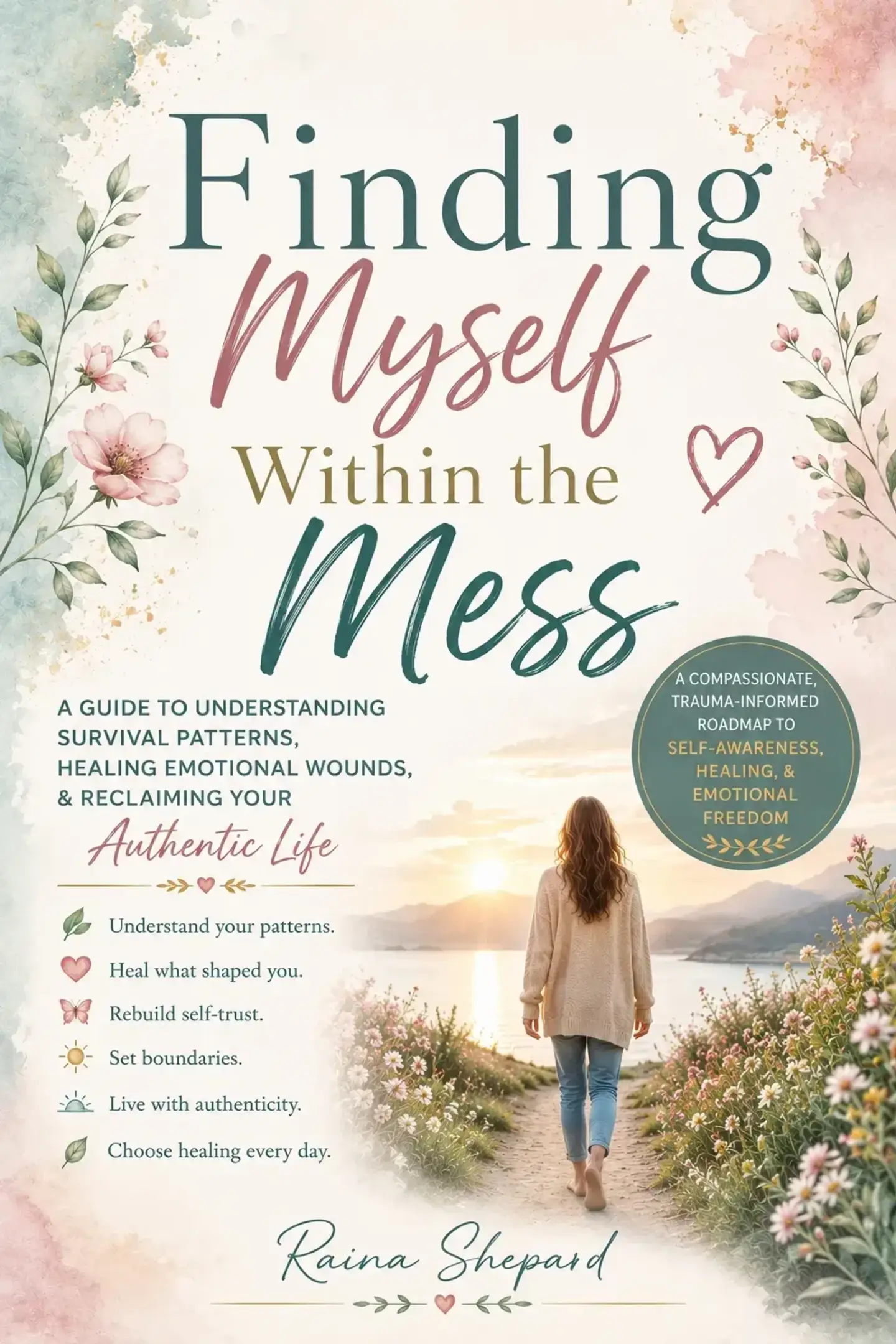
In Finding Myself Within the Mess, the movement toward healing is reflected in its very title: the self is not necessarily gone because life became chaotic. Sometimes the self is buried beneath fear, grief, coping, and the roles you adopted to remain acceptable or safe.
Finding yourself may not feel like discovering a brand-new person. It may feel more like meeting the quiet parts of you that were waiting beneath the noise.
Your preferences. Your boundaries. Your curiosity. Your sense of humor. Your capacity for tenderness. Your right to want something without defending it.
You may also begin to rewrite the language you use with yourself. Instead of “I am damaged,” you might say, “I am healing from something that shaped me.” Instead of “I always ruin relationships,” you might say, “I am learning how fear affects the way I connect.” Instead of “I should be over this,” you might say, “This season is asking for patience.”
The language is not a decoration.
It becomes a companion.
You choose relationships that do not require constant self-abandonment
When you are used to survival, intensity can feel like love. Uncertainty can feel familiar. You may mistake emotional pursuit, withdrawal, jealousy, or crisis for evidence that a relationship matters.
Healing does not make you immune to unhealthy patterns. It makes those patterns harder to romanticize.
You start noticing how often you are explaining basic needs, managing someone else’s emotions, shrinking to preserve harmony, or accepting inconsistency because consistency feels unfamiliar. You begin to understand that love is not supposed to require the disappearance of your own voice.
This is not an overnight transformation. You may still feel drawn toward what you know, especially when what you know has been painful. Familiarity can be powerful, even when it is not kind.
But over time, you may develop a new definition of closeness: one that includes honesty, boundaries, repair, and mutual care. You may become willing to leave the room, end the conversation, or loosen your grip on a connection that repeatedly asks you to betray yourself.
That is not cruelty.
Sometimes, it is the beginning of self-respect.
Books such as Breaking the Dark: A Recovery of What Haunts Us and The Hard Road Home: From Grit to Grace explore this difficult movement from being shaped by old wounds to meeting yourself with greater honesty and compassion. You can learn more about Raina Shepard’s emotionally resonant work through the Raina Shepard website.
You make room for pleasure, not just relief
Survival is often organized around relief.
You want the argument to end. The panic to pass. The message to arrive. The appointment to be over. The house to stay quiet. The difficult person to be satisfied.
Living introduces another question: What brings you genuine pleasure?
At first, you may not know.
That is common. When your energy has been devoted to preventing harm, joy can feel impractical. You may feel restless during peaceful moments or guilty when something good happens. You may wait for happiness to become safe before allowing yourself to feel it.
Try beginning with smaller things.
A song that softens the edges of the day. Fresh air against your face. A book that understands something you have never been able to say aloud. Warm bread, clean sheets, a walk without an agenda, laughter that arrives before you can stop it.
You do not have to build an entirely new life in a single season. You can begin by letting small, gentle experiences count.
As The Hard Road Home: From Grit to Grace suggests, the road may still be difficult while also becoming more than difficulty. There can be beauty beside the grief, tenderness beside the anger, and hope that does not demand you deny what happened.
Living does not mean you never return to survival mode
There will be days when an old response comes back quickly.
A familiar fear may tighten your chest. A relationship may activate a wound you thought had healed. A difficult season may leave you withdrawn, watchful, or numb again.
This does not mean you have failed.
Healing is not a straight line from pain to peace. It is a growing ability to return. To the present, to your body, to your values, to safe people, and to the self you are still becoming.
The change may look like recovering more quickly. It may look like asking for support sooner, recognizing the trigger earlier, or speaking to yourself with less cruelty afterward. It may look like choosing one honest conversation instead of another week of silent resentment.
The past may remain part of you.
However, it does not have to remain in charge.
And perhaps that is what actually changes when you stop managing your trauma and begin learning to live: you no longer measure healing by whether you feel nothing. You measure it by whether you can feel something, and still remain present, still make a choice, still reach for what is real and good.
Not perfectly.
Not permanently.
But more often than before.